How Orbits Work: A Beginner's Guide to Falling Around Earth
An orbit is just falling, but missing the ground. The intuition behind why satellites stay up, why ISS goes 27,000 km/h, and how Newton predicted it 350 years ago.
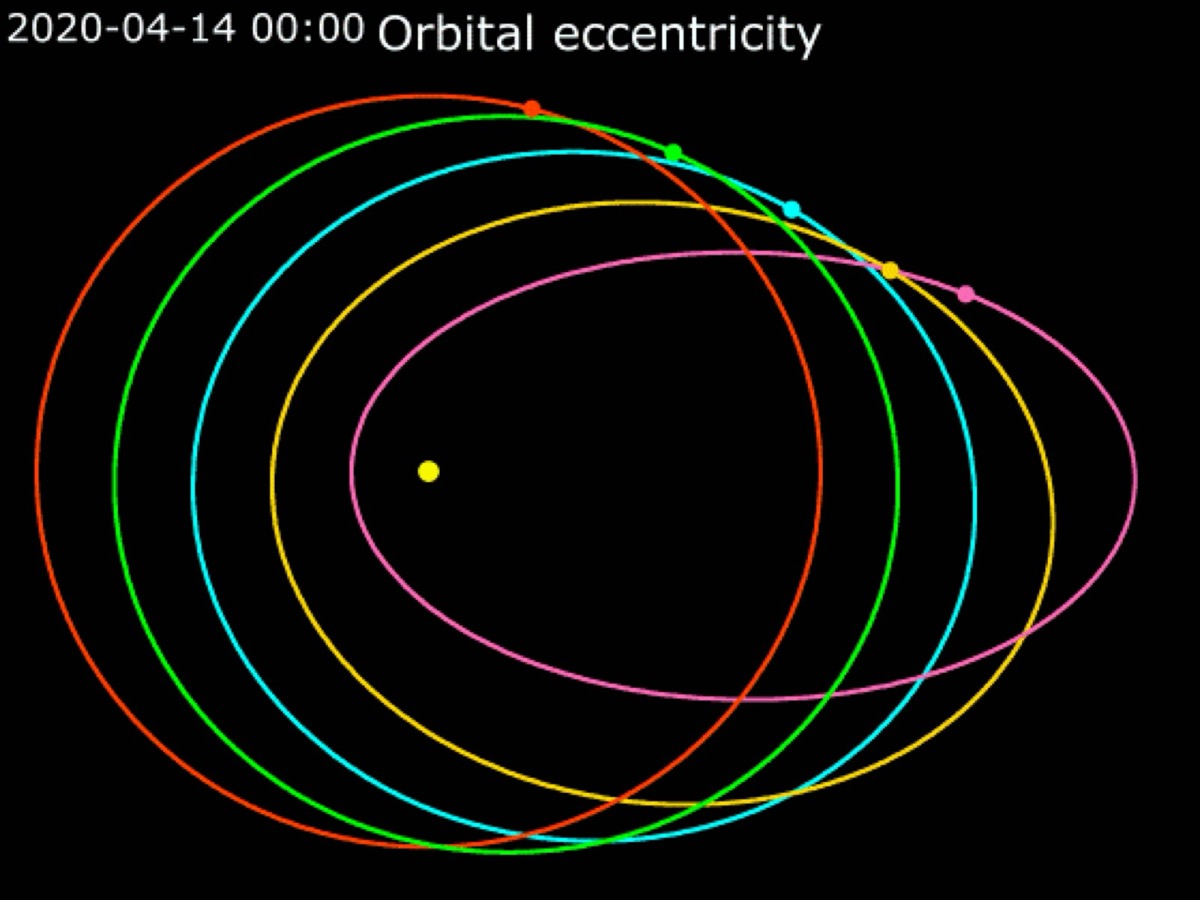
An orbit is the simplest idea in space. You fire something fast enough, sideways, and it keeps falling — but Earth keeps curving away under it just as fast. Newton drew the picture in 1687: a cannonball fired from a tall mountain hard enough to miss the ground forever. That is what every satellite is doing right now.
Why faster means higher
To keep up with the curve of Earth at low altitude, you need to move sideways at about 7.8 km/s. Higher up, gravity is slightly weaker, so the speed needed is a little less. The Moon, 384,000 km up, only needs about 1 km/s to stay in orbit. The relationship is set by Kepler's third law and Newton's gravity.
Common orbital speeds
- Low Earth Orbit (~400 km)
- ~7.66 km/s (27,600 km/h)
- Geostationary Orbit (35,786 km)
- ~3.07 km/s
- Lunar surface (orbiting low)
- ~1.68 km/s
- Lunar orbit at Moon's distance
- ~1.02 km/s
- Mars surface (orbiting low)
- ~3.55 km/s
- Escape velocity from Earth
- ~11.19 km/s
Why an orbit is not exactly a circle
Most real orbits are ellipses. The closest point is called perigee; the farthest is apogee. Energy stays constant — the satellite goes faster when closer, slower when farther. Kepler's second law states that a line from the satellite to the planet sweeps equal areas in equal times.
What it takes to change an orbit
You change altitude with a forward burn at one side of the orbit, then a second burn half an orbit later — a Hohmann transfer. You change inclination with a sideways burn, which is expensive in fuel because you are working against the satellite's velocity vector. Orbital mechanics is the engineering of choosing burns that minimize fuel.
Frequently asked questions
Why don't satellites slow down?
In low Earth orbit there is faint atmospheric drag, so satellites slowly lose altitude unless they boost. In medium and high orbits, drag is negligible and they can stay aloft for centuries.
Can an orbit decay all the way to the surface?
Yes. Without boosting, low-orbit satellites eventually re-enter and burn up. The ISS reboost regularly to maintain altitude.
Is the Moon falling toward Earth?
Yes — continuously. It misses Earth because it has enough sideways velocity to keep curving around instead of hitting it.
Get every launch in your pocket.
Real-time alerts, live ISS tracking, AR sky mode, and synchronized T-0 haptic across every device worldwide.
Download on the App Store