Booster Recovery 101: Droneships, Catch Towers, and RTLS
After launch, rocket boosters land back on Earth. The three primary methods: return to launch site, autonomous droneship landing, and catching the booster at the tower.
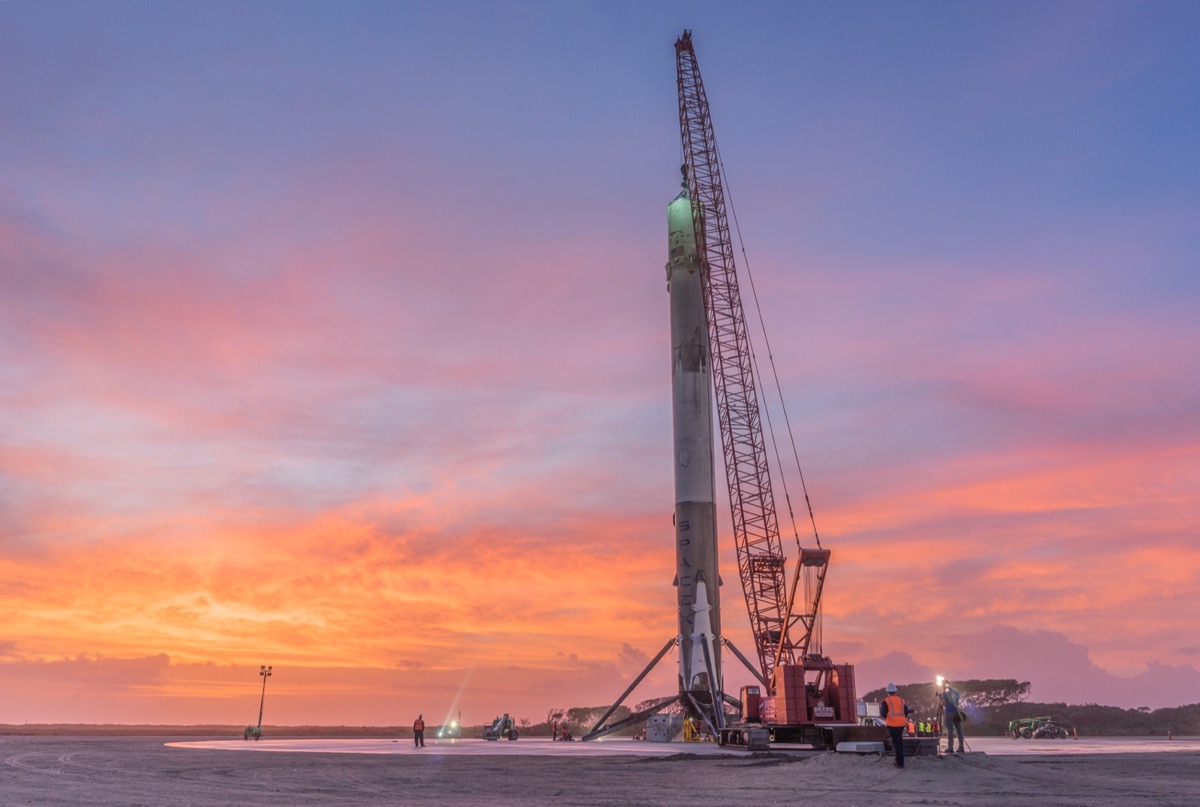
In 2010, every orbital rocket was thrown away after one use. By 2026, Falcon 9 has flown individual boosters more than 25 times each. The transition to reuse depended on solving one engineering challenge: how to return a 70-meter-tall, 25-ton empty rocket to a precise landing spot from suborbital trajectory.
Three landing methods
- RTLS (Return to Launch Site) — the booster reverses course after stage separation and lands at a pad near the launch site. Used for lighter payloads.
- Droneship landing — the booster continues downrange and lands on an autonomous platform at sea. Used when payload mass forbids RTLS.
- Catch tower (Mechazilla) — the booster is caught mid-air by giant chopstick arms on the launch tower. Pioneered by SpaceX Starship.
How a Falcon 9 lands
- After main engine cutoff and stage separation, the booster flips around using cold-gas thrusters.
- A boostback burn (3-engine for RTLS, or none for droneship) sets the trajectory home.
- Grid fins deploy, providing aerodynamic control during atmospheric reentry.
- A reentry burn (3-engine) slows the booster as it enters the atmosphere.
- A landing burn (1-engine) decelerates the booster the last few hundred meters.
- Landing legs deploy, and the booster touches down vertically.
- Falcon 9 first stage mass (empty)
- ~25 metric tons
- Touchdown speed
- ~1-2 m/s vertical
- Precision
- Within meters of target
- SpaceX droneships
- "Of Course I Still Love You", "Just Read the Instructions", "A Shortfall of Gravitas"
- Most flights, single booster
- 25+ as of 2026
Why catch instead of land?
Landing legs add mass. For Starship's Super Heavy booster — 70 m tall, 230 tons empty — landing legs would be a significant payload penalty. SpaceX's solution: catch the booster mid-air with the launch tower's chopsticks. The booster has no legs at all. After catch, it is set directly back on the launch mount for refurbishment.
How precision became possible
Real-time GPS, modern flight computers, and grid fins all contribute. The biggest technical breakthrough was throttling deeply enough to hover. Older engines could not throttle below thrust-to-weight ratio of ~1, so they could not slow to a stop. Falcon 9's Merlin can throttle low enough to perform a final landing burn that ends with vertical velocity at zero.
Frequently asked questions
How accurate is a Falcon 9 landing?
Within meters of the target. Droneship landings hit a pad about 80 m × 50 m; landing pads on land are similar.
Has a Falcon 9 ever missed?
Several early attempts failed. Successful landings became routine by 2017. Recent failures are extremely rare.
Will all rockets eventually be reusable?
Most major new launchers in development (Neutron, Stoke, Terran R, Starship) target reuse. Some legacy rockets remain expendable. The economic logic increasingly favors reuse for high-cadence operators.
Get every launch in your pocket.
Real-time alerts, live ISS tracking, AR sky mode, and synchronized T-0 haptic across every device worldwide.
Download on the App Store