Apogee, Perigee, and Why They Matter for Every Satellite
Most orbits are ellipses, not circles. Apogee and perigee are the two key points — and they shape everything from solar panel design to mission planning.
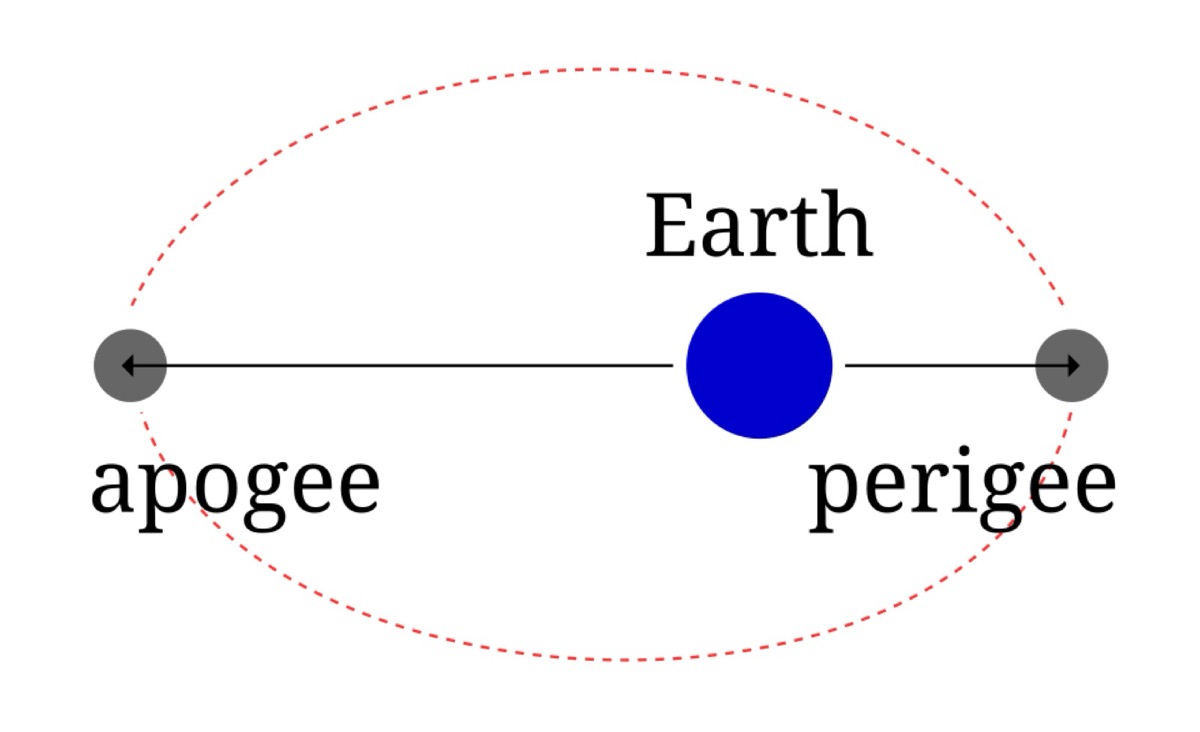
Every elliptical orbit has two extremes. Apogee is the farthest point from Earth — where the satellite moves most slowly. Perigee is the closest — where it moves fastest. Together they determine the orbit's shape and most of its operational properties.
Why orbits are elliptical
Newton's law of gravity, applied to two bodies, has only one stable solution: a conic section. Below escape velocity, the conic is an ellipse. Circular orbits are a special case where eccentricity equals zero. Most natural and engineered orbits are slightly elliptical, with eccentricity between 0 and 1.
Apogee and perigee for famous orbits
- ISS
- Apogee ~420 km, perigee ~415 km — nearly circular
- Hubble
- Apogee ~547 km, perigee ~535 km
- Geostationary
- Apogee = perigee = 35,786 km (perfectly circular)
- Molniya orbits
- Apogee ~40,000 km, perigee ~600 km
- Geostationary Transfer Orbit
- Apogee ~35,786 km, perigee ~200 km
How apogee and perigee are used
- Communications satellites in Molniya orbits spend most of their time over high latitudes by parking their slow apogee over Russia or Canada.
- GTO (Geostationary Transfer Orbit) is an elliptical orbit launched first, with the satellite raising its perigee at apogee with onboard propulsion.
- Sun-synchronous orbits use precise inclination and eccentricity to maintain a constant local solar time on the surface below.
How they change over time
Atmospheric drag pulls perigee down and circularizes orbits. Solar pressure and lunar gravity perturb high orbits. Active satellites perform station-keeping maneuvers to maintain their target apogee and perigee. Without maintenance, orbits drift and eventually decay.
Frequently asked questions
Why is the ISS perigee lower than its apogee?
Even small atmospheric drag is uneven around the orbit, so the ISS's orbit naturally drifts toward eccentricity until reboosts re-circularize it.
What is a sun-synchronous orbit?
A near-polar orbit at ~98° inclination with a precise altitude that uses Earth's J2 oblateness to maintain a constant local time over the ground — ideal for Earth imaging.
How do you raise perigee?
Perform a forward (prograde) burn when at apogee. The opposite burn, retrograde, lowers perigee.
Get every launch in your pocket.
Real-time alerts, live ISS tracking, AR sky mode, and synchronized T-0 haptic across every device worldwide.
Download on the App Store