Voyager 1 and 2: The 47-Year-Old Spacecraft Still Sending Data
Voyager 1 and 2 launched in 1977. Both still operate from beyond the solar system. How their tech keeps working, what they are sending, and how long they can last.
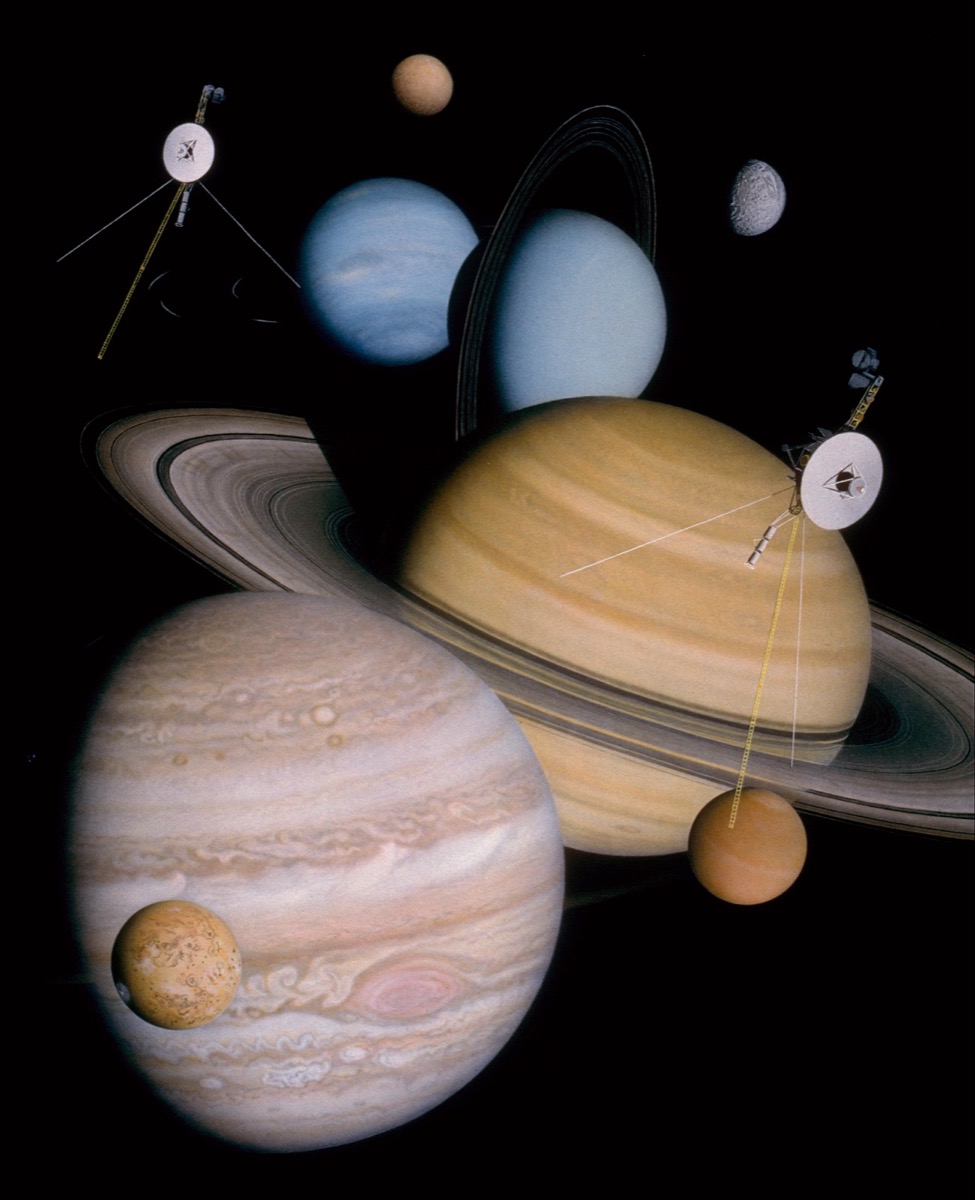
Voyager 1 launched September 1977. As of 2026, it is the most distant human-made object — over 24 billion km from Earth. Its sister Voyager 2 follows at over 20 billion km. Both still send data, still receive commands, and still answer questions about the heliosphere boundary that no other spacecraft will reach for decades.
A grand tour with planetary alignment
In 1977, the outer planets were aligned in a way that occurs once every ~175 years. Voyager 2 used Jupiter's, Saturn's, and Uranus's gravity to slingshot to Neptune — the only spacecraft to visit all four giant planets. Voyager 1 took a faster route past Jupiter and Saturn before turning to head out of the solar system.
How they still work
- Power: each spacecraft has plutonium-238 RTGs. Power output decays slowly; instruments are turned off as power dwindles.
- Communications: NASA's Deep Space Network sends and receives signals; round-trip light time exceeds 45 hours for Voyager 1.
- Instruments still active: cosmic ray detectors, magnetometer, plasma wave instrument, particle detectors.
- Data rate: roughly 160 bits/second — slow even by 1977 standards but enough for the science.
- Voyager 1 launch
- September 5, 1977
- Voyager 2 launch
- August 20, 1977
- Voyager 1 distance (2026)
- ~24 billion km (165 AU)
- Voyager 2 distance (2026)
- ~20 billion km (137 AU)
- Speed
- ~17 km/s relative to Sun
- Heliopause crossing
- Voyager 1: 2012; Voyager 2: 2018
The Golden Record
Each Voyager carries a 12-inch gold-plated copper phonograph record with 116 images, greetings in 55 languages, sounds of Earth, and 90 minutes of music selected by Carl Sagan and his team. The records are addressed to any civilization that might find them in the next billion years — a message in a bottle from a young technological species.
How long can they last?
NASA continues turning off instruments to conserve power. Both Voyagers are expected to be able to communicate at least into the early 2030s, when power output drops below the threshold for operations. After that, they remain in a long, silent journey toward distant stars — Voyager 1 will pass within 1.7 light-years of the star Gliese 445 in roughly 40,000 years.
Frequently asked questions
Are the Voyagers in interstellar space?
Yes. Both have crossed the heliopause, the boundary between the Sun's solar wind and the interstellar medium.
Will they hit anything?
Almost certainly not in our lifetimes. The space between stars is vast and nearly empty.
How does NASA still talk to Voyager 1?
Through the Deep Space Network's 70-meter dishes. Signal-to-noise is challenging at that distance, requiring careful coding and patience.
Get every launch in your pocket.
Real-time alerts, live ISS tracking, AR sky mode, and synchronized T-0 haptic across every device worldwide.
Download on the App Store