Apollo 11 in Context: Why Landing on the Moon in 1969 Was Almost Impossible
Apollo 11 used computers less powerful than a calculator and worked with paper checklists. The reality of how humans first walked on the Moon — engineering and grit.
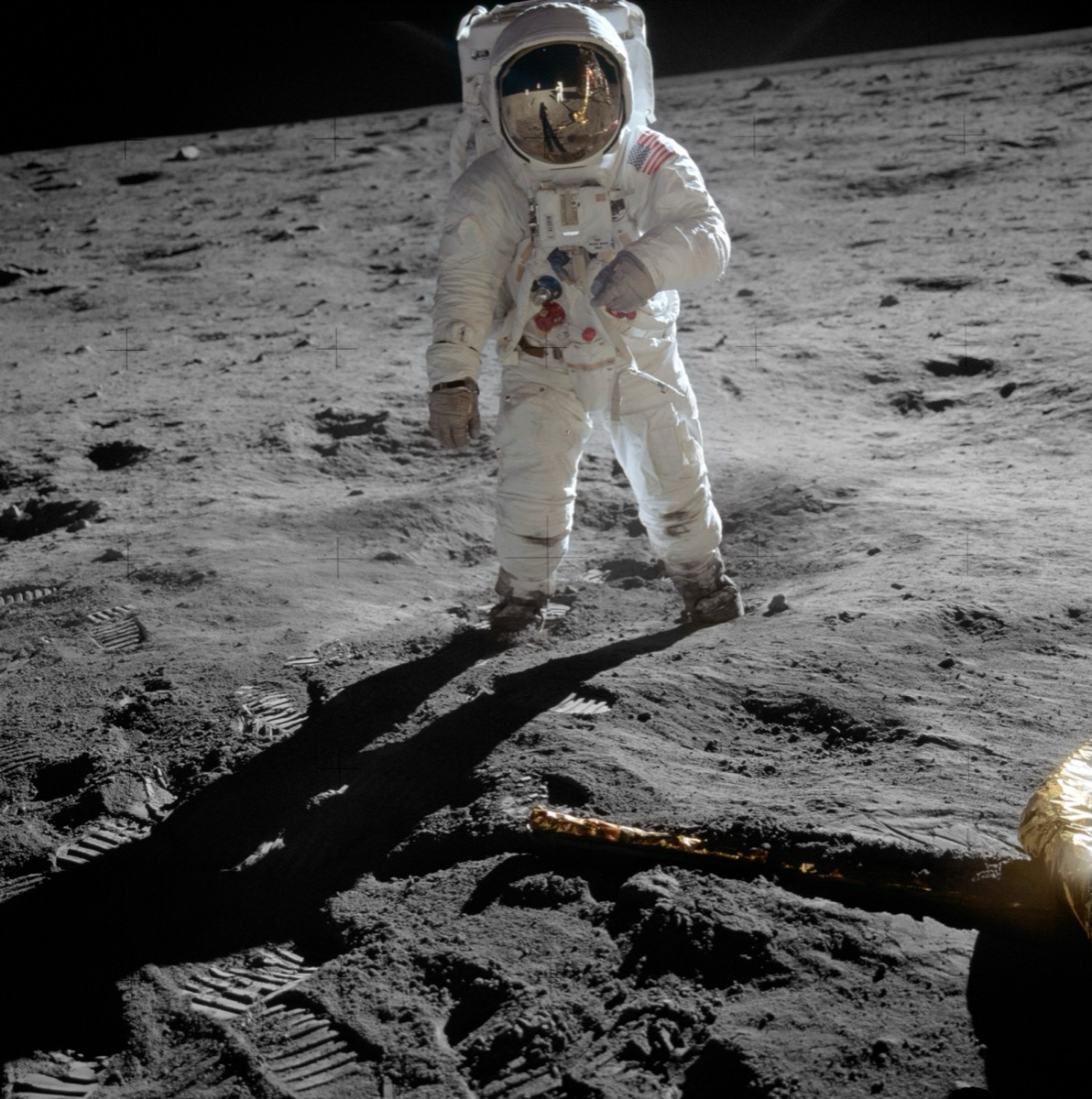
On July 20, 1969, Neil Armstrong and Buzz Aldrin landed the Lunar Module Eagle in the Sea of Tranquility while Michael Collins orbited overhead in the Command Module Columbia. They had less computing power than a modern smart light switch, paper checklists strapped to their wrists, and pressure suits that limited their vision and dexterity. They pulled it off.
The technology in 1969 terms
- Apollo Guidance Computer: 64 KB of read-only memory and 4 KB of read-write memory; the user interface was a numeric keypad with 2-digit verb-noun command codes.
- Saturn V: 110 m tall, 7.5 million pounds of thrust at liftoff, three stages, all expendable, hand-built engines.
- Lunar Module: descent and ascent stages, hypergolic propellants, walls so thin they could be punctured with a screwdriver.
- Spacesuits: 21 layers of fabric, water-cooled garments, gloves stiff enough that astronauts could grip but not fine-manipulate.
The 1202 alarm
During final descent, the AGC reported a 1202 alarm — executive overflow. The cause was a rendezvous radar accidentally feeding data into the computer in addition to the landing radar, overloading the processor. Engineer Steve Bales in Mission Control had to make a real-time call: continue the landing or abort. He continued. The computer was designed to drop low-priority tasks under load. Eagle landed seconds before Armstrong manually reduced approach to find a clear spot.
- Launch date
- July 16, 1969
- Landing date
- July 20, 1969 (UTC), 20:17:40
- Mission duration
- 8 days, 3 hours, 18 minutes
- Lunar surface time
- 21 hours, 36 minutes
- EVA duration
- 2 hours, 31 minutes
- Lunar samples returned
- 21.55 kg (47.5 lb)
- Crew
- Neil Armstrong, Buzz Aldrin, Michael Collins
Michael Collins, alone
Collins orbited the Moon alone for 21.5 hours. Each time the Command Module passed behind the Moon, all communication with Earth and the lunar surface cut out for about 47 minutes. Collins later described the experience as not lonely but uniquely peaceful — and acknowledged he understood his role as the necessary third crew member, even if he never set foot on the surface.
What it took on Earth
Apollo 11 was the visible tip of an effort that employed 400,000 people across NASA, contractors, and universities. The Apollo program peak budget was 4.4% of the entire federal budget — a level of national investment that has not been matched in space since. Modern crewed lunar programs operate at a fraction of that funding intensity.
Frequently asked questions
How long until humans return to the Moon?
NASA is targeting Artemis III for the late 2020s — the first crewed lunar landing since Apollo 17 in December 1972.
Where is the Apollo 11 landing site?
Tranquility Base, in Mare Tranquillitatis, latitude 0.67°N, longitude 23.47°E.
Can you see the Apollo landing sites from Earth?
Not directly. The Lunar Reconnaissance Orbiter has imaged each site at high resolution, showing the descent stages and tracks.
Get every launch in your pocket.
Real-time alerts, live ISS tracking, AR sky mode, and synchronized T-0 haptic across every device worldwide.
Download on the App Store