NASA Earth Science: How Satellites Watch Our Planet 24/7
Twenty-five active NASA Earth-observing missions measure climate, oceans, ice, fires, and ecosystems. Here is what they see, why it matters, and where to find the data.
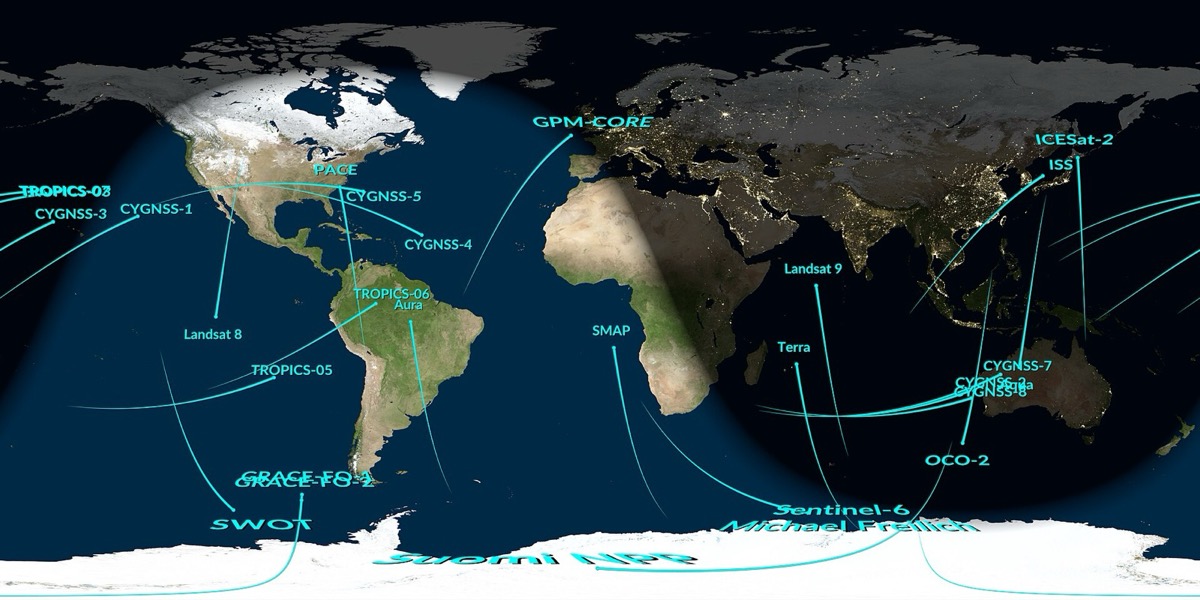
NASA operates one of the largest Earth-observation fleets in the world — currently 25+ active missions watching the planet across the electromagnetic spectrum. Together they measure climate, weather, ice, oceans, biosphere, atmosphere, and more, with data freely available to anyone.
Key active missions
- Landsat 9 — continues a 50-year-long record of land surface imaging in optical and thermal bands.
- NISAR — joint NASA/ISRO synthetic aperture radar that watches surface deformation and ice motion.
- PACE — Plankton, Aerosol, Cloud, and ocean Ecosystem mission, characterizing ocean biology and air pollution.
- ICESat-2 — laser altimetry that measures ice sheet elevation changes to a few centimeters.
- GRACE-FO — twin satellites that measure variations in Earth's gravity to track water and ice mass.
- OCO-2 / OCO-3 — Orbiting Carbon Observatory, mapping atmospheric CO₂.
- TEMPO — geostationary air quality observer over North America.
How the data flows
Almost all NASA Earth science data is free and open. EarthData (earthdata.nasa.gov) is the central portal. Specialized portals — Worldview, Giovanni, AppEEARS — make data accessible to researchers, educators, and the public without requiring specialized software.
- Active NASA Earth missions
- 25+
- Total data archive
- ~80+ petabytes (and growing)
- Data access cost
- Free for science and public use
- Largest single mission cost
- ~$1B for flagships like NISAR
- Update frequency for global coverage
- Daily for many products
Why it matters
Climate science depends on continuous, calibrated, multi-decade satellite records. Disaster response — from wildfires to hurricanes — uses Earth observation in near-real time. Agriculture, fisheries, and water management worldwide rely on free NASA data. The fleet is some of the most cost-effective public infrastructure ever built.
Frequently asked questions
Are NASA Earth science data really free?
Yes, including for commercial use. NASA's open data policy is one of the cornerstones of modern Earth science.
Can I use Worldview without an account?
Yes. Just navigate to worldview.earthdata.nasa.gov and explore.
How do I cite NASA satellite data?
Each mission has a recommended citation, listed on the dataset page in EarthData.
Get every launch in your pocket.
Real-time alerts, live ISS tracking, AR sky mode, and synchronized T-0 haptic across every device worldwide.
Download on the App Store