Starlink and Light Pollution: How Mega-Constellations Affect Astronomy
Mega-constellations leave streaks across telescope images and brighten the radio spectrum. What astronomers measure, what operators have changed, and what is still unsolved.
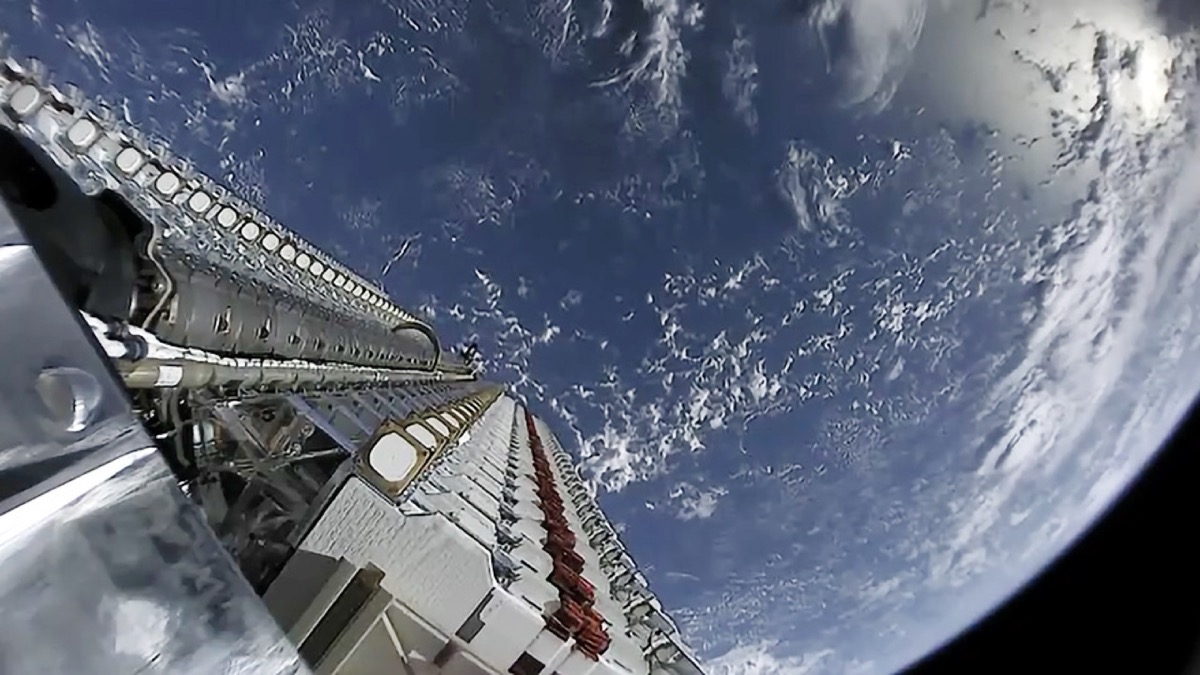
A satellite passing through a telescope's field of view leaves a bright streak — a streak that crosses many pixels at exactly the moment a long exposure is gathering rare photons. With thousands of new LEO satellites, those streaks are no longer occasional. They are part of the cost of doing astronomy from Earth in the LEO era.
How big is the impact?
- Wide-field surveys like the Rubin Observatory expect ~30% of their long exposures to contain at least one satellite streak.
- Twilight observations are most affected because satellites still catch sunlight while the ground is dark.
- Radio astronomy is affected by satellite-to-ground transmissions; the SKA in Western Australia coordinates with operators to avoid sensitive bands.
What SpaceX has changed
- DarkSat — added a darkening coating; reduced brightness by ~50% but added thermal complications.
- VisorSat — added sunshade visors that block sunlight from reflecting off bright surfaces.
- Black mirror coatings — used on later Starlink generations to reduce reflectivity further.
- Orientation changes — satellites now orient large flat surfaces away from observers to reduce specular flashes.
- Pre-mitigation Starlink brightness
- Magnitude ~5.5 (visible to naked eye)
- Post-mitigation V1.5
- Magnitude ~7 (telescope-only)
- Astronomers' target
- Magnitude 7+ (recommended by IAU)
- Newer V2 satellites
- Brighter due to size; mitigations ongoing
How astronomers fight back
The Rubin Observatory developed software to detect, mask, and statistically subtract satellite trails. Survey scheduling avoids known constellation tracks at twilight when possible. The IAU's Center for the Protection of the Dark and Quiet Sky from Satellite Constellations (CPS) coordinates global advocacy and standards.
What is still unresolved
Brightness alone is one issue. Out-of-band radio emissions, atmospheric reentry deposition of metals, and global cumulative impact across multiple constellations are areas of active research and policy negotiation. Operators and astronomers continue to share data and refine mitigations.
Frequently asked questions
Can satellites still be seen with the naked eye?
Many can, especially during twilight. Newer Starlinks are dimmer than the first generations but still visible to dark-adapted eyes.
Will James Webb be affected?
No. JWST is at the L2 Lagrange point, 1.5 million km away. Satellites in LEO are not in its line of sight to deep space.
What is the IAU's position?
The IAU has called for satellite operators to keep brightness below magnitude 7 and is working with operators on standardized mitigations.
Get every launch in your pocket.
Real-time alerts, live ISS tracking, AR sky mode, and synchronized T-0 haptic across every device worldwide.
Download on the App Store