Starlink Direct to Cell: How Standard Phones Now Connect to Satellites
Direct to Cell turns every modern smartphone into a satellite phone — no app, no special device. Inside the technology and what it means for global connectivity.
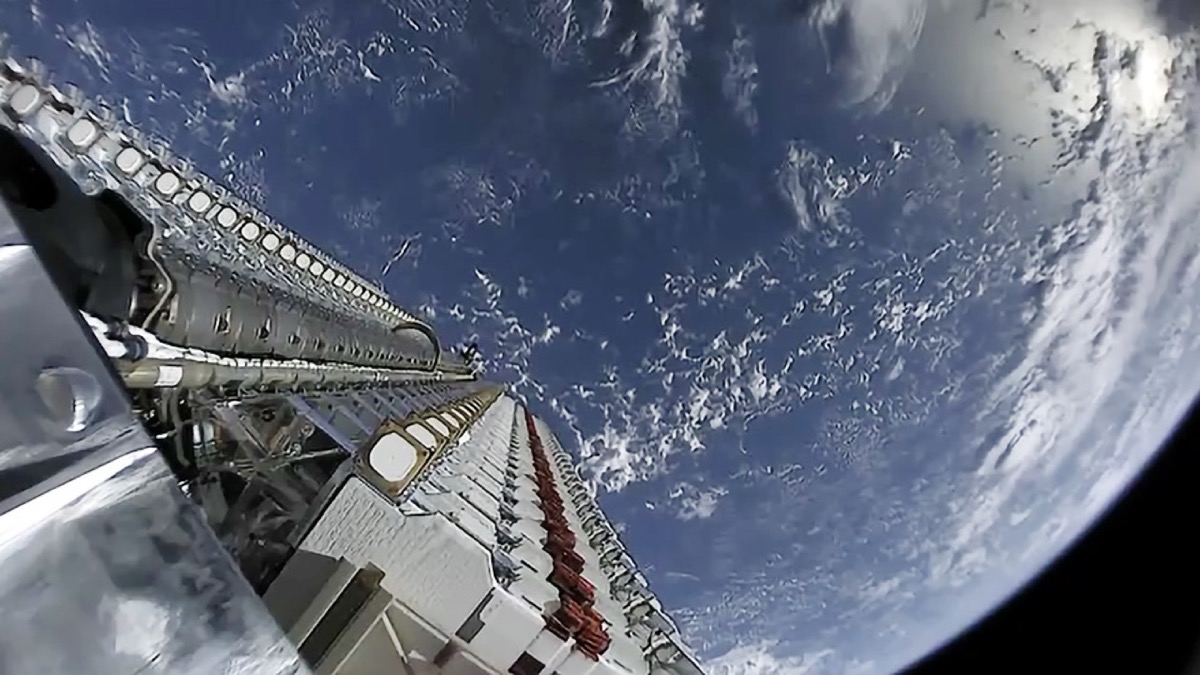
Starlink Direct to Cell beams a 4G/LTE signal directly to standard, unmodified smartphones. There is no app, no special antenna — your phone connects to a Starlink satellite the same way it connects to a cell tower. Texting started rolling out in 2024-2025, with voice and limited data following.
How it actually works
A modified Starlink V2 satellite carries a large phased-array antenna built specifically for cellular spectrum. The satellite acts as a cell tower in space, broadcasting on PCS-band frequencies licensed to participating carriers. Your phone's modem treats it like a normal tower with very long propagation delay.
Why this is hard
- A Starlink satellite is 340-570 km away. A normal tower is a few kilometers. The link budget is challenging.
- The satellite moves at 27,000 km/h — Doppler shift is about 25 kHz, far more than terrestrial systems handle.
- Many phones in the same beam means the satellite handles thousands of simultaneous links.
- Spectrum coordination requires deals with each carrier in each country.
- Service launch
- 2024-2025 (text-first rollout)
- First carrier partner
- T-Mobile US
- Other partners
- Optus (AU), Rogers (CA), KDDI (JP), and several others
- Phone compatibility
- Most LTE phones from the past several years
- Initial features
- SMS, then voice, then limited data
What this changes
Dead zones effectively disappear for basic communications. Hikers, mariners, and rural residents can text 911 from anywhere with a clear sky. International travelers stay reachable without roaming. For first responders, satellite-direct cellular is a rescue-grade fallback when terrestrial networks go down in disasters.
Limitations to remember
- Indoor reception is poor — satellites cannot punch through buildings the way close towers can.
- Throughput per satellite is shared. Initial service is text-and-voice, not video calls.
- Coverage depends on a Starlink satellite being overhead and appropriate carrier permissions.
Frequently asked questions
Will my phone work with Starlink Direct to Cell?
If your phone supports the LTE bands your carrier licenses for satellite use, and your carrier has a partnership, then likely yes. Compatibility lists are published by each carrier.
How fast is Starlink Direct to Cell?
Initial service is sized for text and basic voice. Throughput will grow as more V2 satellites with the cellular antenna are deployed.
Does it work indoors?
Generally not well. Like all satellite services, it needs a relatively clear view of the sky.
Get every launch in your pocket.
Real-time alerts, live ISS tracking, AR sky mode, and synchronized T-0 haptic across every device worldwide.
Download on the App Store