The Nancy Grace Roman Space Telescope: Hubble's Wide-Field Successor
Roman has Hubble's sharpness — over 100 times the field of view. It will hunt dark energy, find rogue planets, and survey a billion galaxies. Launching 2027.
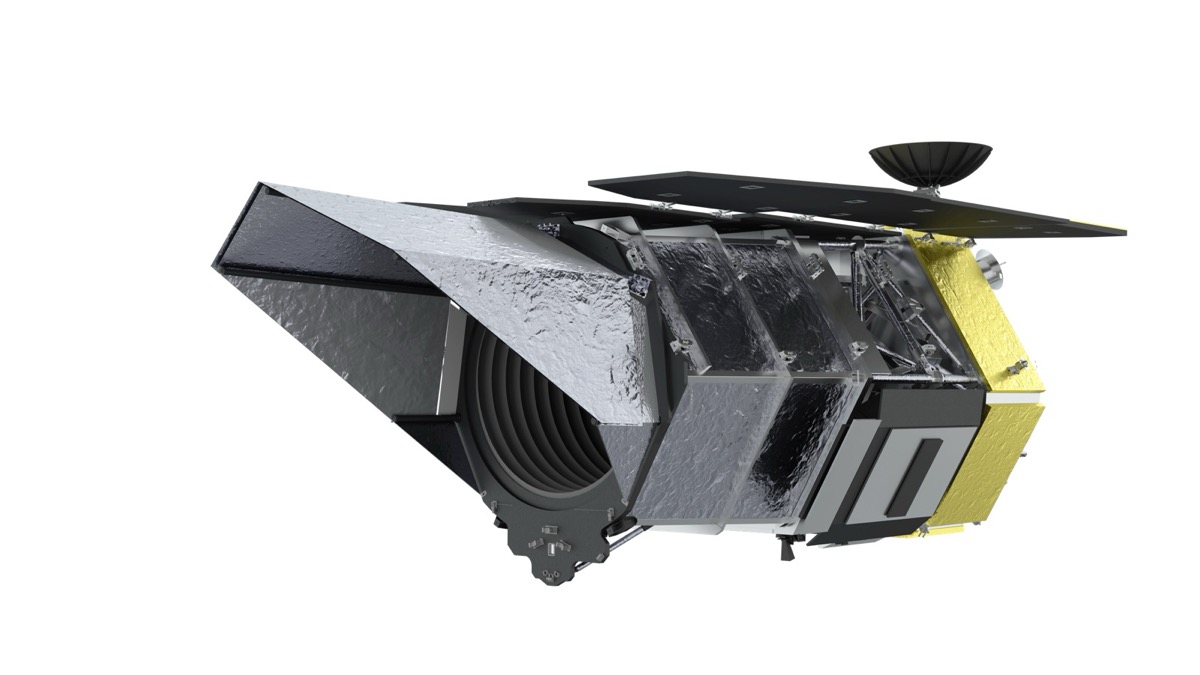
The Nancy Grace Roman Space Telescope has the same primary mirror size as Hubble — 2.4 m — and the same diffraction-limited sharpness. But its field of view is more than 100 times wider. Where Hubble images one galaxy in fine detail, Roman images thousands at the same time. It is a survey machine the universe has never seen before.
Three big science goals
- Map dark energy by measuring the geometry and growth of cosmic structure across billions of galaxies.
- Discover thousands of exoplanets via microlensing — a technique especially good at finding cold and rogue planets.
- Image and characterize directly the atmospheres of mature, Jupiter-like worlds with the coronagraph instrument.
- Primary mirror
- 2.4 m (a former NRO spy satellite mirror, donated to NASA)
- Field of view
- 0.28 square degrees — 100× Hubble's
- Wavelength range
- 0.48 – 2.3 µm (visible to near-infrared)
- Location
- Sun-Earth L2 Lagrange point
- Launch
- Targeted for late 2027
- Mission length
- 5-year prime mission, propellant for 10+
How microlensing finds planets
When a star with planets passes in front of a more distant star, gravity bends the light and creates a small magnification. Planets show up as additional spikes in the brightness curve. The technique is most sensitive to cold planets at large orbital distances — the kinds Kepler and TESS could not easily see. Roman is expected to find an estimated 100,000 exoplanets.
The coronagraph experiment
Roman carries the Coronagraph Instrument as a technology demonstration — a system to block the glare of a star and image its planets directly. It targets contrast levels never achieved in space, and the lessons learned feed directly into the Habitable Worlds Observatory, NASA's flagship mission of the 2040s.
How Roman complements JWST
Webb is a deep, narrow telescope optimized for infrared. Roman is a wide, fast telescope optimized for surveying. Roman discovers; Webb follows up. The two together form a tag team for discovery and characterization.
Frequently asked questions
Is Roman a replacement for Hubble?
Not exactly. Roman has Hubble's primary mirror size but a wide field of view and infrared focus. Hubble continues separately for now in visible/UV.
Why is Roman launching so soon after JWST?
JWST and Roman address different science goals. The cadence of major flagship missions is set decades in advance through the astronomy decadal survey.
Where does the Roman name come from?
Nancy Grace Roman was NASA's first Chief of Astronomy and is widely credited as the "Mother of Hubble" for her role in driving the space telescope concept through Congress and NASA management.
Get every launch in your pocket.
Real-time alerts, live ISS tracking, AR sky mode, and synchronized T-0 haptic across every device worldwide.
Download on the App Store