How Real-Time ISS Tracking Apps Actually Work
Behind every "ISS is over you now" notification is a chain of orbital math. Here is how Launchcast and other trackers compute the station's position to sub-kilometer precision.
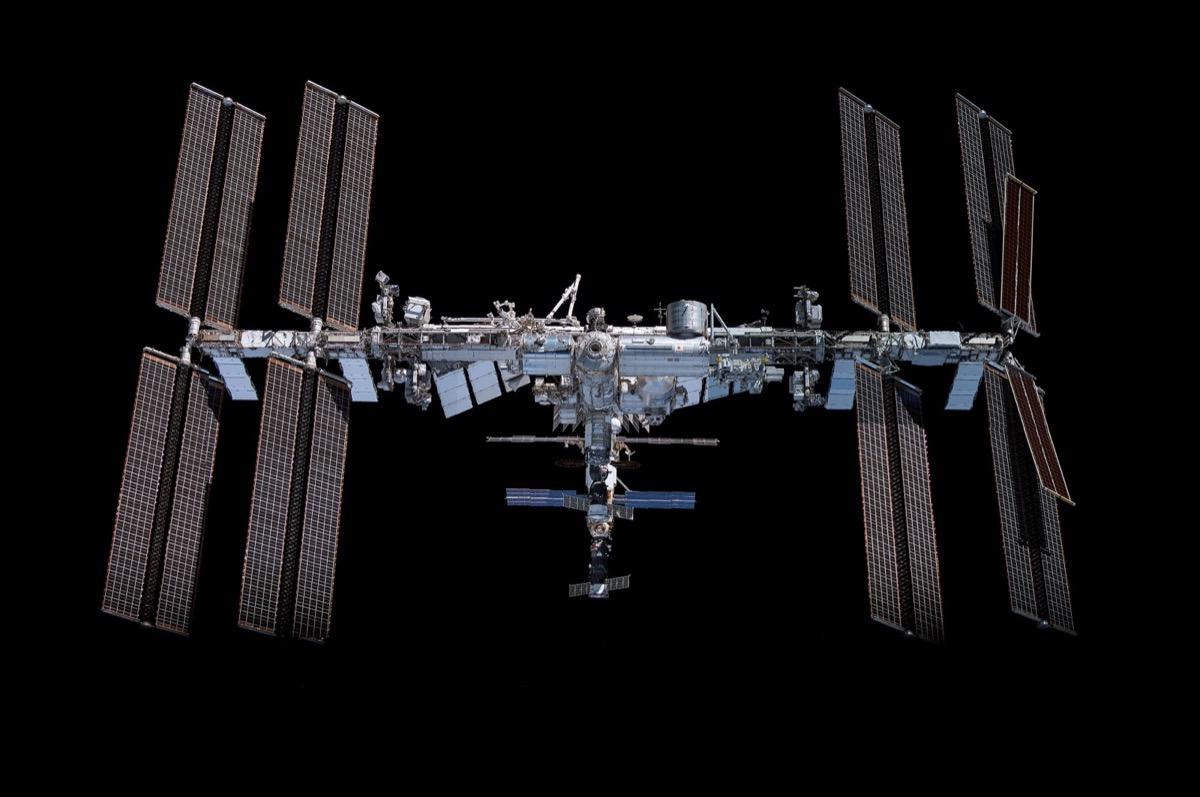
When Launchcast tells you the ISS is overhead, it is not pulling that data from a single live feed. It is computing the station's position from a small text file called a TLE — Two-Line Element set — that the US Space Force publishes daily. Here is how the math works.
The TLE format
A TLE is a 138-character snapshot of an orbit at a specific moment. It contains six classical orbital elements (eccentricity, inclination, RAAN, argument of perigee, mean anomaly, mean motion), plus an epoch timestamp and drag-related parameters. The US Space Force publishes TLEs for every tracked object on space-track.org and CelesTrak mirrors them publicly.
The SGP4 propagator
SGP4 (Simplified General Perturbations 4) is the standard algorithm for turning a TLE into a position at any future time. It models gravity, atmospheric drag, and the Earth's oblateness. For the ISS, SGP4 is accurate to within a few hundred meters for several days from the TLE epoch.
- TLE update frequency
- ~Daily for the ISS
- Position accuracy
- Within a few hundred meters
- Velocity accuracy
- Within a few centimeters per second
- Compute time per propagation
- <1 ms on a phone
- Data source
- space-track.org (US Space Force)
From TLE to "look up now"
- Fetch the latest TLE for the ISS (NORAD ID 25544).
- Run SGP4 forward to compute Earth-Centered Inertial (ECI) position and velocity at the desired time.
- Convert ECI to ECEF (Earth-Centered Earth-Fixed) using the current sidereal time.
- Convert ECEF to your local topocentric frame (azimuth, elevation, range) using your latitude, longitude, and altitude.
- If the elevation is positive and the satellite is in sunlight while you are in darkness, it is visible.
Why some apps disagree
Different apps may use different TLE freshness, different visibility thresholds, or different approximations for sunlight calculation. Apps also sometimes apply additional refinements — atmospheric refraction near the horizon, the ISS' actual size and reflectivity for brightness predictions, or local terrain masking.
Frequently asked questions
Is the data live from the ISS?
No. The data is from US Space Force radar tracking, with updated TLEs published daily. The ISS itself does not broadcast its position.
How often does Launchcast refresh ISS data?
Launchcast updates TLEs at least daily and propagates positions in real time on your device.
Can I track satellites other than ISS?
Yes. The same SGP4 + TLE method works for every tracked satellite. Apps differ in which satellites they expose to users.
Get every launch in your pocket.
Real-time alerts, live ISS tracking, AR sky mode, and synchronized T-0 haptic across every device worldwide.
Download on the App Store