Hubble vs. James Webb: Two Telescopes, Two Different Universes
They orbit at different distances, see different wavelengths, and answer different questions. A side-by-side look at the two flagship space telescopes.
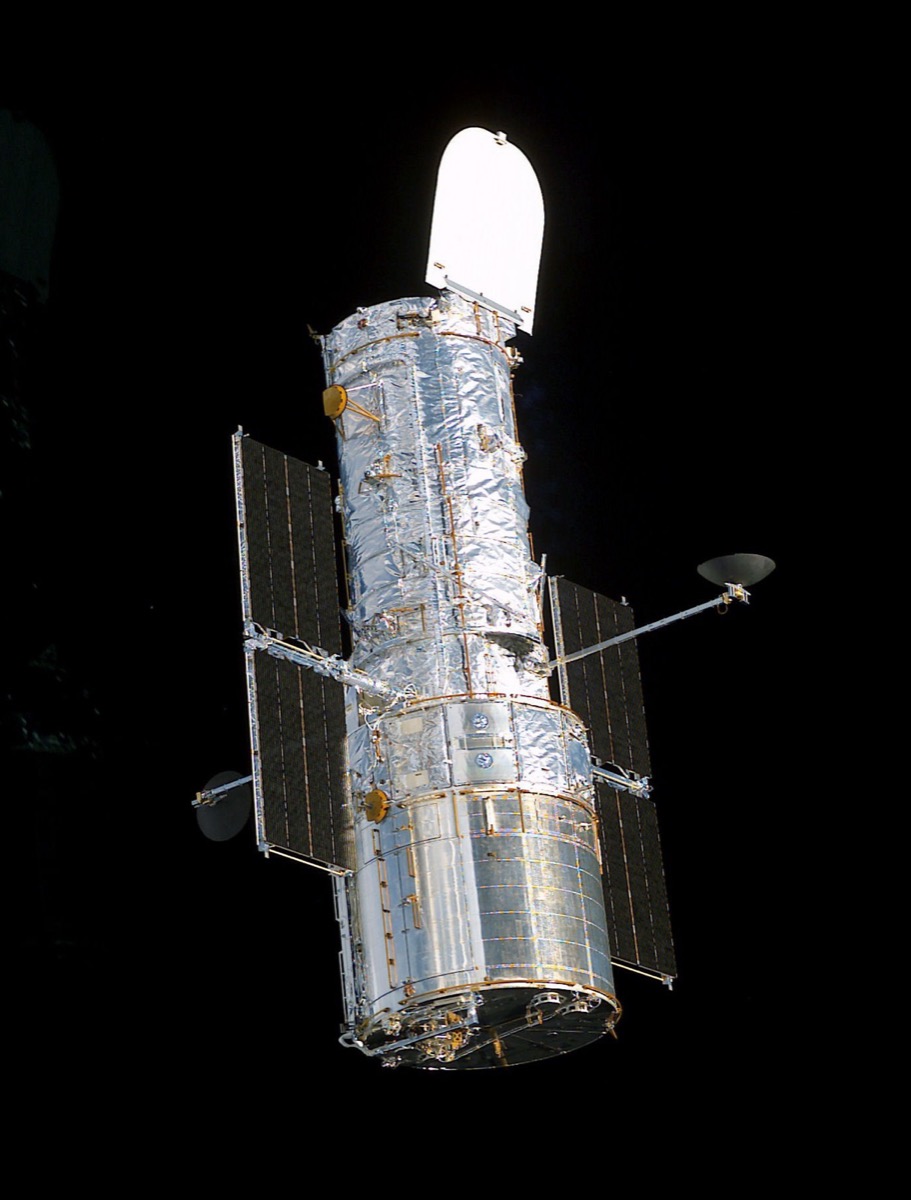
Hubble has been imaging the universe in visible and ultraviolet light from low Earth orbit since 1990. James Webb, since 2022, has been doing infrared spectroscopy from the L2 Lagrange point. They are not competitors — they answer different questions and routinely complement each other on follow-up programs.
Where they live
- Hubble altitude
- 535 km (low Earth orbit)
- JWST distance
- 1.5 million km (L2 Lagrange point)
- Hubble accessibility
- Reachable by Shuttle (servicing missions 1993-2009)
- JWST accessibility
- Not serviceable — no spacecraft can reach it
- Hubble lifespan
- Operating since April 1990
- JWST lifespan
- Designed for 10 years, projected 20+
Wavelengths and capabilities
- Hubble: ultraviolet, visible, near-infrared (0.1 to 1.7 µm).
- JWST: near-infrared and mid-infrared (0.6 to 28.3 µm).
- Hubble excels at sharp visible imaging and UV spectroscopy.
- JWST excels at high-redshift galaxies, cool dust, and exoplanet atmospheres.
Why orbit choice matters
Hubble at 535 km has the Earth filling much of its sky and shifts in and out of sunlight every 95 minutes. That is fine for visible work but limits cooling. JWST at L2 has Earth, Sun, and Moon all on the same side — its sunshield blocks them all simultaneously, allowing the mirror to cool to -233 °C, essential for infrared work.
How often they work together
On many science targets, Hubble images first or in parallel, then JWST does follow-up infrared spectroscopy. Galaxies, exoplanet host stars, and supernovae all benefit from this two-telescope approach. The Webb-Hubble overlap years are a uniquely powerful time in observational astronomy.
Frequently asked questions
Will JWST replace Hubble?
Not directly — they observe different wavelengths. As long as Hubble continues to function, both will operate.
Why does JWST look like a beach umbrella?
The five-layer sunshield is the size of a tennis court. It blocks heat from the Sun, Earth, and Moon so the infrared mirror can stay cold.
Is Hubble still scientifically active?
Yes. Hubble continues delivering science with reduced gyroscopes after its 2024 entry into "1-gyro mode" for longevity.
Get every launch in your pocket.
Real-time alerts, live ISS tracking, AR sky mode, and synchronized T-0 haptic across every device worldwide.
Download on the App Store