Europa Clipper: NASA's Mission to a Hidden Ocean World
Europa Clipper is on its way to Jupiter's icy moon to investigate whether the ocean beneath the ice could host life. Here is what it will do, and when.
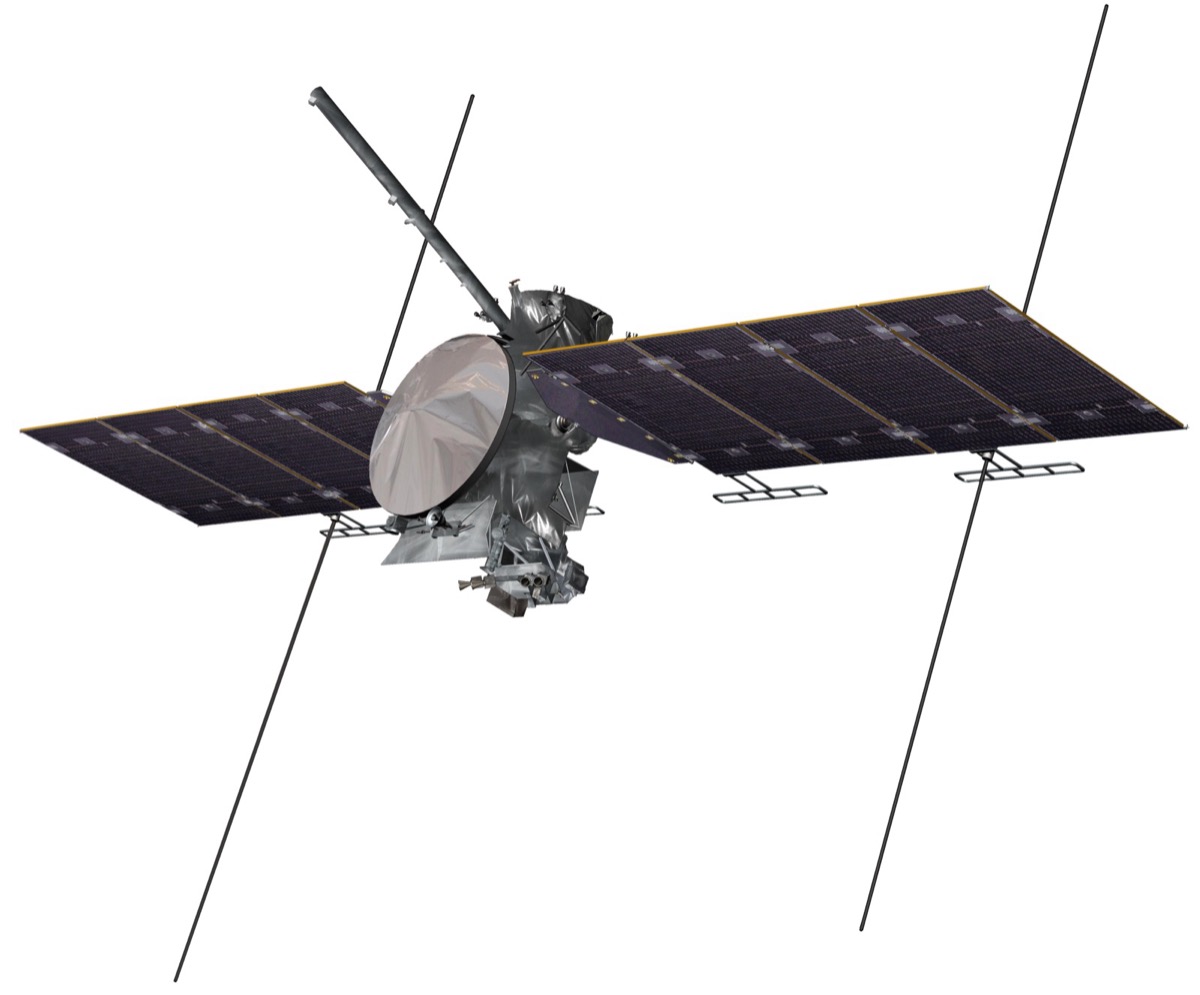
Beneath Europa's icy shell, more water flows than in all of Earth's oceans combined. Europa Clipper is the spacecraft NASA built to study that ocean from above — to characterize its chemistry, the thickness of the ice, and whether the conditions for life exist there today.
Why not orbit Europa?
Jupiter's radiation belts would destroy a Europa orbiter's electronics within weeks. Clipper instead orbits Jupiter on a long looping path and makes 49 close flybys of Europa — diving in, gathering data, and dashing out before radiation damage accumulates.
- Launch vehicle
- SpaceX Falcon Heavy (October 2024)
- Arrival at Jupiter
- 2030
- Mass
- 6,065 kg (largest interplanetary spacecraft NASA has built)
- Solar arrays
- 30 m wingspan — solar power at 5 AU
- Flybys of Europa
- 49 planned
- Closest approach
- As low as 25 km above the ice
The science instruments
- Ice-penetrating radar to image the structure of the shell down to the ocean.
- Magnetometer to measure the induced magnetic field and confirm the salty ocean depth.
- Mass spectrometers to taste any plumes erupting through the ice.
- High-resolution cameras and spectrometers to map composition and geology.
- Thermal instrument to find recently active warm spots on the surface.
What counts as a habitable world?
Astrobiologists look for three things: liquid water, the chemistry needed by life, and an energy source. Europa likely has all three — water from the ocean, organic chemistry from cometary delivery, and energy from tidal heating and possible hydrothermal vents on the seafloor.
How long will the mission last?
The prime mission lasts about four years at Jupiter, with potential extension. Each Europa flyby returns more data than the entire Galileo mission collected from the moon in the 1990s.
Frequently asked questions
Could Europa host life?
It has the three ingredients we associate with habitability — water, chemistry, energy — but no evidence of life has been detected. Clipper aims to characterize the habitability, not to find organisms.
Why was Falcon Heavy chosen over SLS?
NASA originally planned to launch on SLS. Falcon Heavy was selected as a cost-effective alternative once it was clear the SLS schedule would not align with Clipper's ready date.
How thick is Europa's ice?
Estimates range from a few kilometers to over 30 km. Clipper's ice-penetrating radar is designed to settle that question.
Get every launch in your pocket.
Real-time alerts, live ISS tracking, AR sky mode, and synchronized T-0 haptic across every device worldwide.
Download on the App Store