Dragonfly: NASA Is Sending a Nuclear-Powered Helicopter to Titan
In 2034, a rotorcraft the size of a small car will land on Saturn's moon Titan, hop dozens of kilometers between sites, and search for the chemistry that leads to life.
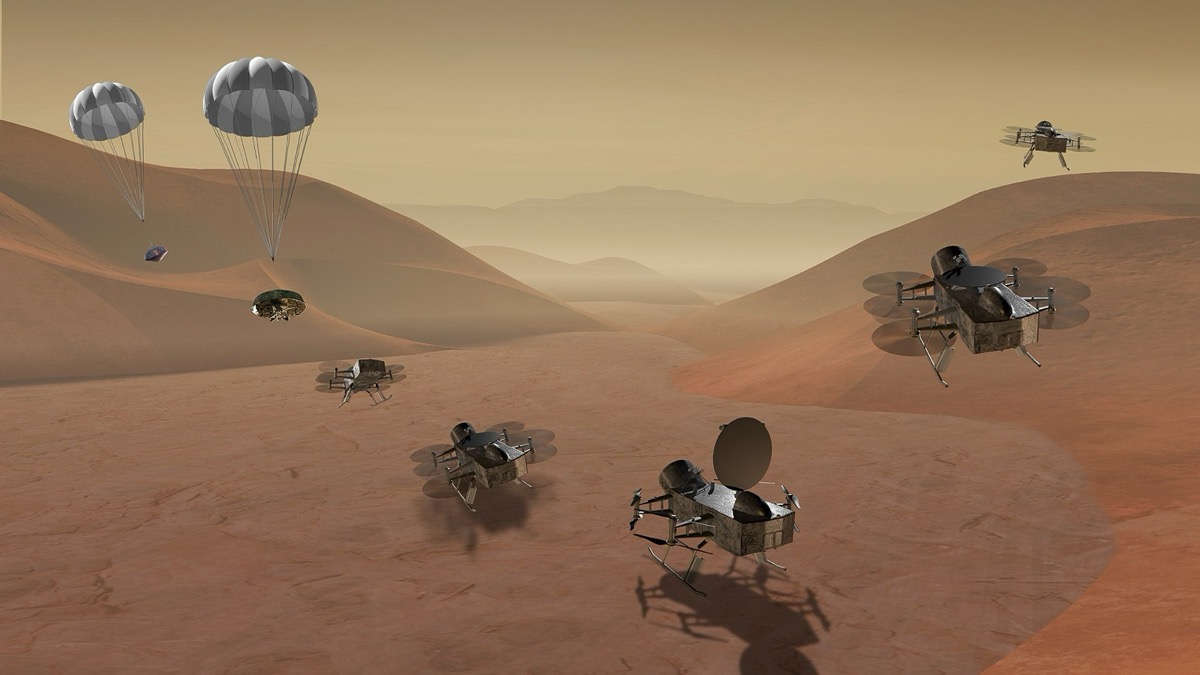
Titan has weather. It has rain, rivers, lakes, and seas — all made of liquid methane and ethane. It has dunes of organic sand. Beneath the surface, a water ocean. NASA's Dragonfly is a rotorcraft built to hop across that alien world, sample its chemistry, and ask whether the molecular precursors to life are forming today.
Why fly instead of drive?
Titan's atmosphere is four times denser than Earth's and gravity is one-seventh as strong. Flight is roughly 35 times easier than at Earth. A rover can crawl meters per day. Dragonfly will hop tens of kilometers per flight — covering ground no rover ever could.
- Launch
- July 2028 (target)
- Arrival at Titan
- 2034
- Power source
- MMRTG — multi-mission radioisotope thermoelectric generator
- Mass
- ~450 kg
- Rotors
- 8 (octocopter design)
- Mission lifetime
- ~3.3 years
- Total flight distance
- ~175 km projected
What Dragonfly will look for
- Complex carbon chemistry that mimics the prebiotic chemistry that led to life on Earth.
- Liquid water mixed with organics — possibly exposed by recent impacts that briefly melted the ice.
- Atmospheric and surface composition across diverse geologic settings.
- Seismic activity, weather, and methane cycle dynamics.
Why Titan is unique
Titan is the only moon in the solar system with a thick atmosphere. It is the only world other than Earth with stable surface liquids. Its hydrology operates with methane in place of water. It is, in many ways, an alternate-chemistry Earth — cold but eerily familiar.
Operating in deep darkness
At Saturn, sunlight is 1% of what reaches Earth. Dragonfly flies at night and recharges by day from its plutonium-238 generator. Titan's thick haze diffuses the dim sunlight into a uniform amber glow that even at noon resembles deep dusk on Earth.
Frequently asked questions
Why is Dragonfly nuclear-powered?
Solar panels would not produce enough energy at Saturn's distance, especially through Titan's hazy atmosphere. The MMRTG provides reliable power for years regardless of conditions.
How fast does Dragonfly fly?
About 36 km/h cruise. Each flight may cover 8 km, with multi-flight expeditions of dozens of kilometers between extended ground science campaigns.
Is Titan considered a candidate for life?
Titan offers two possibilities — exotic methane-based life on the surface, and water-based life in the subsurface ocean. Dragonfly will not detect organisms but will characterize whether the chemistry is possible.
Get every launch in your pocket.
Real-time alerts, live ISS tracking, AR sky mode, and synchronized T-0 haptic across every device worldwide.
Download on the App Store