Artemis III: How NASA Plans to Land the First Woman on the Moon
Artemis III will land humans on the lunar south pole for the first time. Inside the Starship HLS, the suits, the landing site, and the science of looking for water.
Artemis III is the mission that puts boots back on the Moon — and for the first time in history, those boots will include a woman's and a person of color's. Unlike the equatorial Apollo landings, Artemis III targets the lunar south pole, where permanently shadowed craters hold billions of tons of water ice.
A two-spacecraft architecture
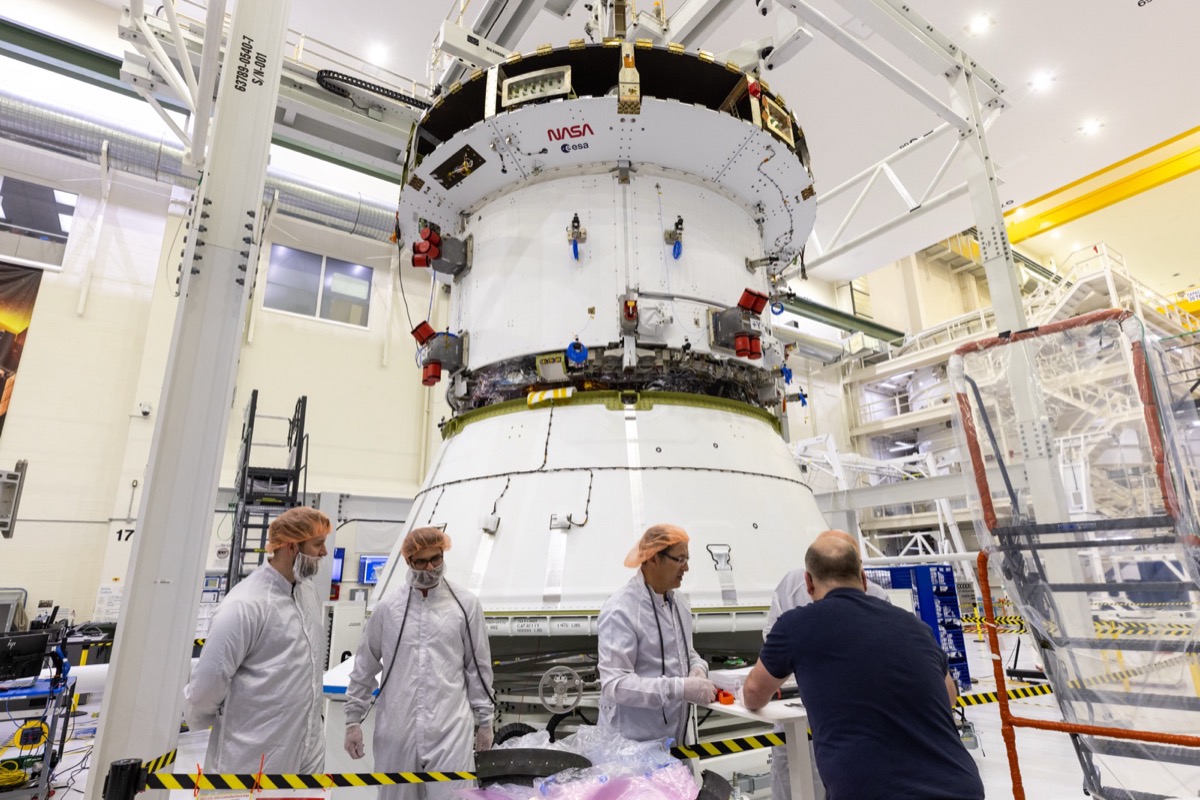
The crew rides Orion to lunar orbit, then transfers to a SpaceX Starship Human Landing System (HLS) that has been pre-positioned. After the surface stay, they ride Starship HLS back up to Orion, which carries them home. It is the most complex crewed mission architecture NASA has ever attempted.
- Crew
- 4 launched, 2 land
- Surface duration
- About 6.5 days
- Landing region
- Lunar south pole (13 candidate sites)
- Lander
- SpaceX Starship HLS — ~50 m tall
- Spacesuit
- Axiom Extravehicular Mobility Unit (AxEMU)
- EVAs planned
- Up to 4
Why the south pole?
- Permanently shadowed craters preserve water ice that has not seen sunlight in billions of years.
- Nearby ridges receive near-constant sunlight, ideal for solar power.
- The ice is a potential resource for drinking water, oxygen, and rocket propellant.
- The geology preserves a record of the early solar system inaccessible at equatorial sites.
The new spacesuit
Axiom Space's AxEMU is a flight-pressurized suit with a flexible bearing in the shoulders, hips, and knees, custom-fitted to a wider range of body sizes than the Apollo A7L. Cooling is achieved with an ice-pack–based heat exchanger replacing the older sublimator, and the helmet uses a high-definition video camera in place of an eyepiece.
The 13 candidate landing sites
NASA narrowed the south polar region to 13 candidate sites including Faustini Rim A, Peak near Shackleton, Connecting Ridge, de Gerlache Rim 1 and 2, and Haworth. Each is selected for sunlight availability, slope, communications, and proximity to permanently shadowed regions of scientific interest.
Science the crew will do
- Drill core samples from permanently shadowed regions and seal them at lunar temperature for return.
- Deploy passive seismic and heat flow experiments — the next generation of Apollo ALSEP packages.
- Photograph the south polar terrain with stereo high-resolution cameras for future base planning.
- Test surface-to-orbit communications via the planned Lunar Gateway architecture.
Frequently asked questions
When will Artemis III launch?
NASA is currently targeting the late 2020s. The schedule depends on Starship HLS readiness, including its propellant transfer in low Earth orbit.
Why does Starship HLS need refueling?
Starship is too large to reach the Moon on a single tank. SpaceX plans to launch a depot to LEO, then ferry propellant up with multiple tankers before the HLS departs for the Moon.
How long will the crew stay on the surface?
About 6.5 days, with up to four EVAs of around two hours each. That is more than triple the Apollo 17 surface stay.
Will the crew see Earth from the south pole?
Yes, but lower on the horizon than from Apollo equatorial sites — Earth hangs at roughly 6° elevation, depending on the exact landing point.
Get every launch in your pocket.
Real-time alerts, live ISS tracking, AR sky mode, and synchronized T-0 haptic across every device worldwide.
Download on the App Store