Starship V2 vs V3: What's Changing in the Next Generation
A side-by-side breakdown of Starship V2 vs Starship V3 — taller stages, more thrust, Raptor 3 engines, payload, and why V3 unlocks Mars-class missions.
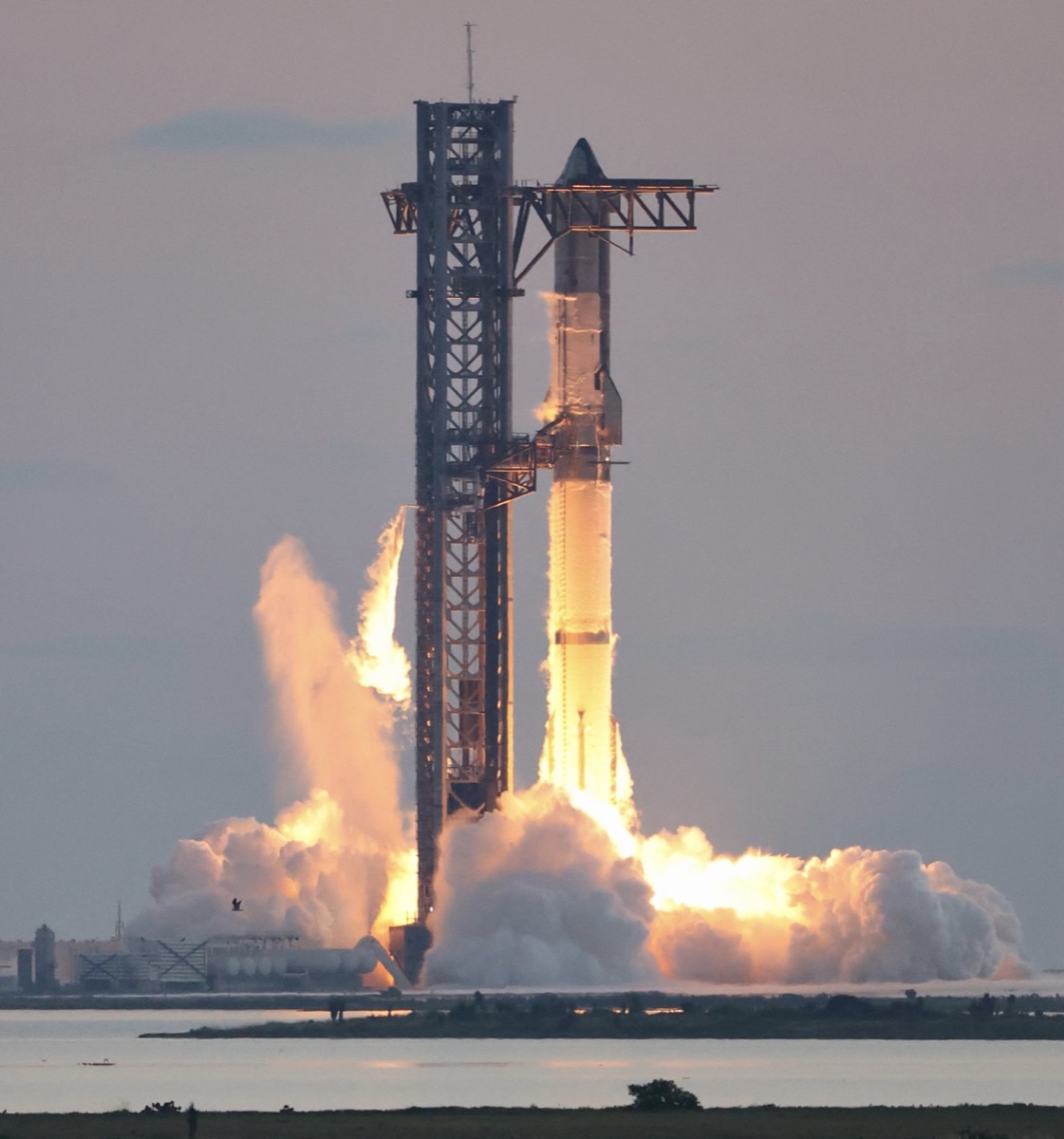
Starship is not a single rocket. It is an evolving platform that has already moved through Block 1, Block 2 (V2), and is now approaching Block 3 (V3). Each generation adds height, propellant volume, thrust, and reliability — pushing payload and reuse closer to the original vision.
Here is what changes between V2 and V3, and why those changes matter for Starlink, the Moon, and Mars.
Starship V2 — the workhorse generation
Starship V2 (Block 2) is the operational generation flying today. It introduced the stretched upper stage with larger propellant tanks, redesigned forward flaps moved leeward to reduce heating, an improved hexagonal tile heatshield, and Raptor 2 engines with higher thrust and improved manufacturability.
- Total height
- ~123 m stacked
- Booster engines
- 33 Raptor 2
- Upper-stage engines
- 6 Raptor (3 SL + 3 vacuum)
- Payload to LEO (reusable, target)
- ~100 t
- Heat shield
- Hexagonal ceramic tiles, mechanically clipped
Starship V3 — the Mars generation
V3 is the next major step. It is taller, with more propellant, and runs Raptor 3 — a redesigned engine that integrates the heat exchangers and plumbing into the engine body itself, eliminating most external piping. The result is more thrust, less mass, and faster manufacturing.
- Total height
- ~150 m stacked
- Booster engines
- 33 Raptor 3
- Per-engine thrust (SL)
- ~280 tf
- Total liftoff thrust
- >100 MN
- Payload to LEO (reusable, target)
- 200+ t
- Heat shield
- Active cooling areas + advanced tiles
Why V3 matters
- Mars architecture requires high payload per ship to keep refueling flight counts reasonable
- HLS Starship needs significant margin for crew, science, and surface assets
- Starlink V2 gen-3 satellites are larger; V3 carries more per flight
- Higher reusability turnaround drops the cost-per-kilogram
The Raptor 3 leap
Raptor 3 is arguably the bigger upgrade than the airframe stretch. By moving plumbing inside the engine body, eliminating heat shields previously needed around external lines, and pushing chamber pressure higher, Raptor 3 simultaneously: increases thrust, reduces mass, simplifies manufacturing, and improves reliability. Each generation of Raptor has improved by 20–30% in some key metrics.
Reusability and tower-catch evolution
V2 demonstrated multiple booster catches at the launch tower. V3 will industrialize that — multiple launch towers, multiple ships per tower, and rapid stack-and-fly turnaround. This is the leap from "we can reuse" to "we can reuse like an airliner."
When does V3 fly?
SpaceX has flown the first V3 test articles and prototype Raptor 3 engines. Operational V3 flights are expected through 2026 alongside continued V2 missions, with V3 progressively replacing V2 on the highest-payload missions.
Frequently asked questions
What is the difference between Starship V2 and V3?
V3 is taller (around 150 m vs 123 m), runs Raptor 3 engines instead of Raptor 2, has higher liftoff thrust, and roughly doubles reusable payload to LEO. The architecture is similar; the scale and engine technology are upgraded.
Is Raptor 3 already flying?
Raptor 3 has been ground-tested and flown on test articles. Full operational V3 flights with all-Raptor-3 engines are expected to ramp through 2026.
How much can Starship V3 lift?
SpaceX targets 200+ metric tons to LEO in fully reusable mode for V3, more in expendable mode — an unprecedented payload class.
Get every launch in your pocket.
Real-time alerts, live ISS tracking, AR sky mode, and synchronized T-0 haptic across every device worldwide.
Download on the App Store