SpaceX Starship: The Complete Guide to the Largest Rocket Ever Built
A complete breakdown of SpaceX Starship — height, thrust, payload, Raptor engines, reusability, and what it means for Mars, the Moon, and the future of space travel.
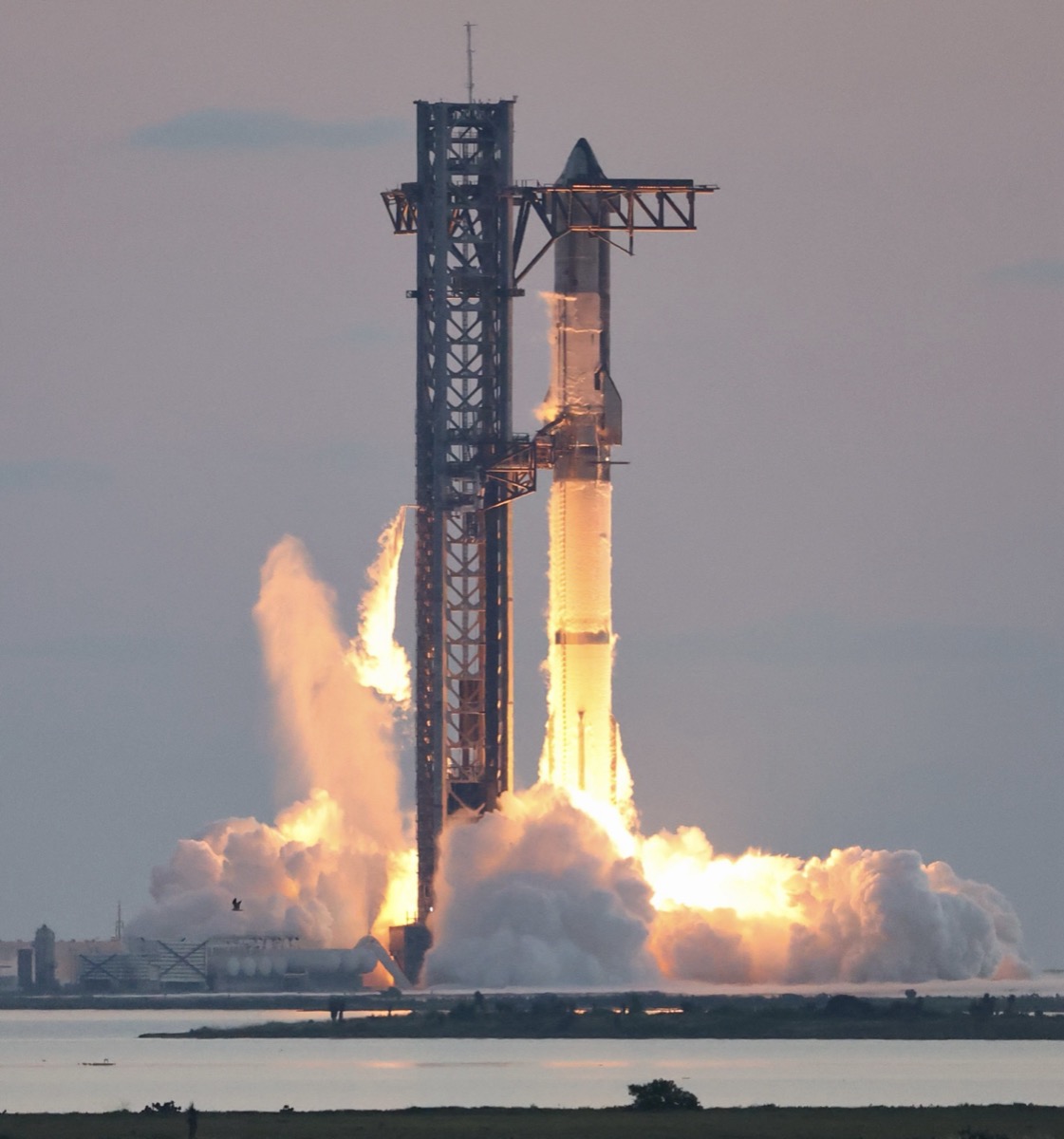
SpaceX Starship is the largest, heaviest, and most powerful rocket ever built. Standing roughly 121 meters (397 ft) tall when fully stacked, it dwarfs the Saturn V that carried Apollo astronauts to the Moon. Yet despite its size, Starship is designed to be fully and rapidly reusable — a feat that, if achieved at scale, would lower the cost to orbit by an order of magnitude.
This guide explains how Starship works, how it compares to other rockets, what missions it is designed to fly, and where it stands in 2026.
What is SpaceX Starship?
Starship is a two-stage, fully reusable, super heavy-lift launch vehicle developed by SpaceX. The system has two parts: a 71-meter first-stage booster called Super Heavy, and a 50-meter second-stage vehicle called Starship. Both stages are made of stainless steel — a deliberate choice that trades a small mass penalty for thermal performance, manufacturability, and cost.
Both stages are powered by Raptor engines, the first full-flow staged-combustion engines ever flown. Super Heavy uses 33 Raptors, while Starship uses six (three for sea level, three vacuum-optimized).
Starship key specifications
- Total height
- 121 m (397 ft) stacked
- Total liftoff mass
- ~5,000 metric tons fueled
- Liftoff thrust
- ~74 MN (16.7 million lbf)
- Payload to LEO (reusable)
- 100–150 metric tons
- Payload to LEO (expendable)
- 250+ metric tons
- Booster engines
- 33 Raptor 2 / Raptor 3
- Upper-stage engines
- 6 Raptor (3 SL + 3 vacuum)
- Propellants
- Liquid methane (CH₄) + liquid oxygen (LOX)
- Reusability
- Both stages, fully and rapidly reusable
Why methane (and not RP-1)?
Most large rockets use kerosene (RP-1) like the Falcon 9, or liquid hydrogen like the Space Shuttle. SpaceX chose methane because of three properties critical to a Mars architecture. Methane is denser than hydrogen (smaller tanks), it burns cleaner than RP-1 (less coking inside engines, better reuse), and crucially, methane and oxygen can be produced on Mars from atmospheric CO₂ and subsurface water ice — letting future Starships refuel for the trip home.
How Starship lands
Super Heavy returns to the launch site and is caught in mid-air by giant mechanical arms — nicknamed "chopsticks" — attached to the launch tower. The booster never touches down on legs, which removes mass and simplifies inspection.
The Starship upper stage is designed for the same: orbital reentry, a controlled "belly-flop" descent through the atmosphere using its four flaps, a final flip to vertical, and a propulsive landing — eventually back at the catch tower.
Starship vs Saturn V vs SLS
- Starship (stacked)
- 74 MN thrust · 100–250 t to LEO · fully reusable
- SLS Block 1
- 39 MN thrust · ~95 t to LEO · expendable
- Saturn V
- 34 MN thrust · 140 t to LEO · expendable
- Falcon Heavy
- 22 MN thrust · 64 t to LEO · partially reusable
What missions will Starship fly?
- Starlink V2 deployment (the constellation that requires Starship-class payloads)
- NASA Artemis III & IV — the Human Landing System (HLS) variant of Starship will carry astronauts to the lunar surface
- Earth-orbit refueling demonstrations — propellant transfer is critical to Mars and Moon architectures
- Crewed missions to Mars (the long-term goal driving the entire program)
- Commercial deep-space science missions (large telescopes, sample-return)
Where Starship stands today
After a series of integrated flight tests starting in 2023, SpaceX has demonstrated the world's first booster catch, successful upper-stage reentry from orbital velocity, and Raptor engine reliability across multiple flights. The current Starship V2 (Block 2) and the upcoming V3 add larger propellant tanks, more efficient Raptors, and improved heatshield tiles.
Operational missions — including paying customers — are now flying, and the FAA has expanded SpaceX's annual launch cadence at Starbase.
Why Starship matters
For most of the space age, getting one kilogram to orbit cost between $10,000 and $25,000. Falcon 9 dropped that to roughly $2,000–3,000 per kilogram. A fully reusable Starship — flying many times per year per ship, with rapid turnaround — could push the cost below $200 per kilogram. That makes orbital infrastructure (manufacturing, telescopes, server farms, fuel depots) economically realistic for the first time.
You can track every Starship flight, view live launch coverage, and get T-0 alerts in the Launchcast iOS app.
Frequently asked questions
How tall is Starship?
Starship stacked on Super Heavy is approximately 121 meters (397 feet) tall — taller than the Saturn V that carried Apollo astronauts to the Moon.
How many engines does Starship have?
The Super Heavy booster has 33 Raptor engines. The Starship upper stage has 6 Raptor engines: 3 sea-level and 3 vacuum-optimized.
Is Starship reusable?
Yes. Both the Super Heavy booster and the Starship upper stage are designed to be fully and rapidly reusable. The booster is caught at the launch tower; the ship is designed for tower catches eventually as well.
When will Starship go to Mars?
SpaceX has not committed to a firm crewed Mars date, but uncrewed cargo Starships are planned for the late 2020s, with the goal of crewed Mars flights as early as the 2030s once propellant transfer and Mars-surface refueling are demonstrated.
Get every launch in your pocket.
Real-time alerts, live ISS tracking, AR sky mode, and synchronized T-0 haptic across every device worldwide.
Download on the App Store